

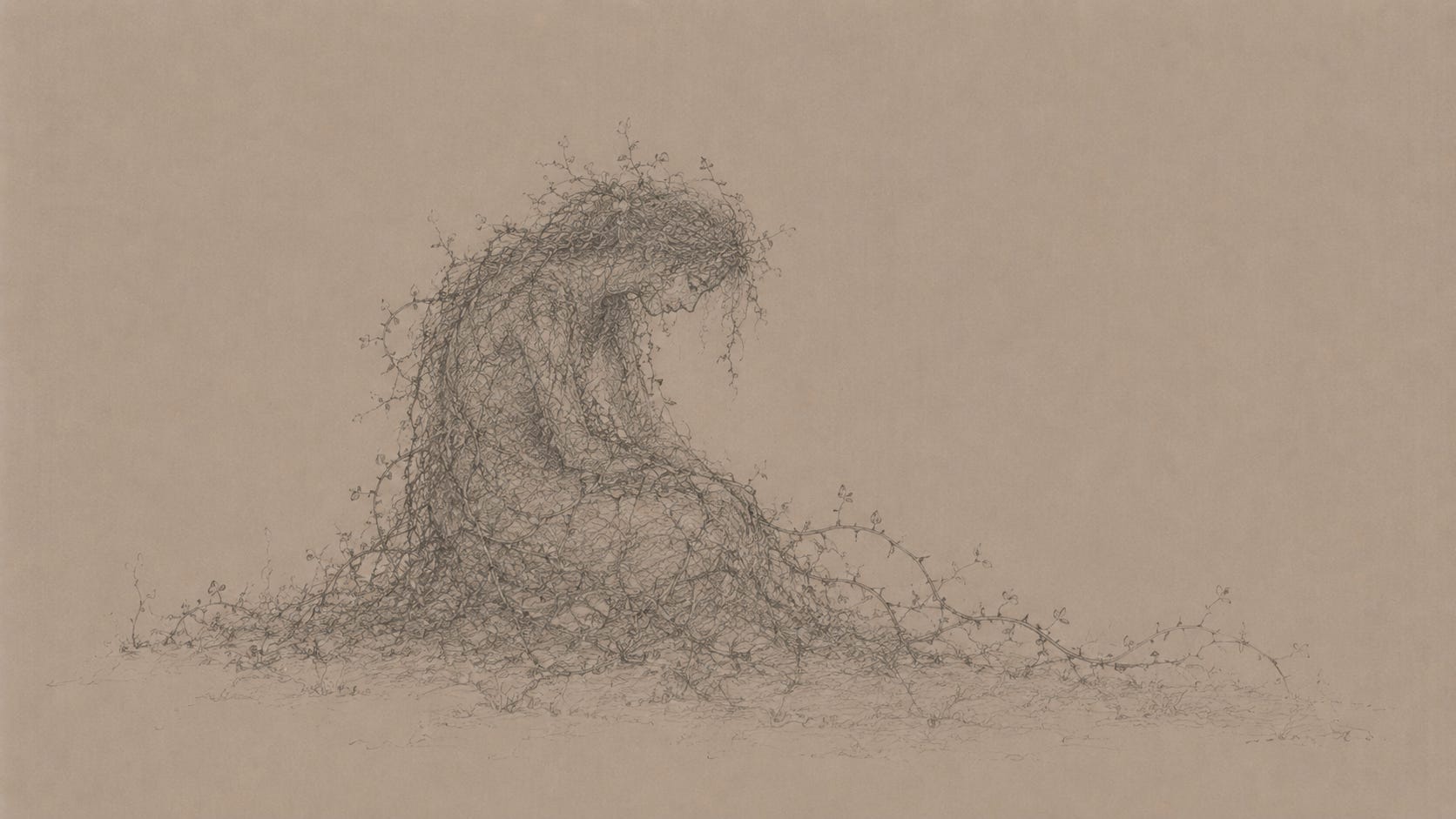
Oftentimes young girls are of the inclination that things from the ground that smell good are to be plucked. Hazel Tinnen, fascinated as she was by the high-class teamakers and their clientele with expensive gossip and intricate fashion, desired to take this inclination one step further: that good smells can be plucked and then brewed.
Growing up in the established trade center of Wul, Hazel’s parents were city organizers - a decidedly unexciting yet necessary role which kept them busy for long periods of the days and nights, thereby giving her long periods of time to occupy herself. Younger Hazel would stalk the market grounds, the trader settlements after hours, asking questions and receiving samples and listening to stories of people from all over the world. But as she grew older, it only took one encounter of a dastardly man with salacious eyes and a horrifying greed to scare her away from committing much time trusting her endeavors to the strangefolk of the traders.
Hazel was born with a sensitivity to the air, being able to quite literally see the currents of air blowing, have a sense for the weather, and carrying a lightness to her being that seemed to lift her steps and blow her in the direction she desired. Her parents were of the same lineage, but it seemed in their transition to Wul, they’d largely given up the ascetic tradition that typically sensitive individuals might watch over. Their obsession with modern luxuries kept their house littered with all manner of interesting trinkets and gadgets, picked up or offered as thank yous from traders who appreciated their stalls being placed more forefront to the flow of traffic.
It didn’t take long for Hazel as a young adult, to fall in love with the murmurations of scent in the currents she witnessed flowing around her. She wound her way to the various upper district tea stalls, frequented for their relative privacy and the quality of selection of teas available. Some connoisseurs would even offer teas with medicinal benefits, promising brews and mixtures that would ease pains, encourage libidinous desires, or offer temporary escapes from the fixed vantage of reality. These were her favorite, as the smells clotted into unique braids that twisted through the air serpentuously. Like her parents before her, Hazel fell into admiring these tea stalls for the elegant clientele who frequented them, the lifestyles they inhabited, and the worldbending possibilities these teas offered.
It was with this in mind that Hazel Tinnen dared to venture into the forest beyond the city walls and cleared tracts of trader settlements for Wul. Most of her life she had been warned that the forest was ripe with danger and threats for the unprepared: venomous snakes, predatorial beasts, and natural traps like poisonous flora and snaring nettels. Yet with her lightness of being, she found it rather easy to avoid detection for the most part and, if found, to evade any who would threaten with a swift kick into the air and balancing on a high branch of a tree. She carried two woven-wicker baskets with cloth towels inside to dry and separate any foraged material from each other, and it was rather easy for her to fill these up with all manner of flower and mushroom: hyacinth and non-venomous nettle, lemongrass and mints, hibiscus and catfallow, silverrod and walnuts, and various colored and sized myceliates. Small insects found on the stems she’d relocate to neighboring flowers next door as she took great discretion to pluck only the best-smelling selection of flora in their respective flocks, never eliminating a patch, only taking a few samples from any region.
As she got home she filled several kettles with water and got to work boiling them all. She took obsessive notes on subjective criteria like feeling, acceptance of heat, smell, texture, body, and made all manner of classification systems to group potentially like or complementary flora together. In this way, Hazel Tinnen, the world’s first alchemist, found her craft.
“I have to find more for my mixtures, these are comfortable but I know everything there is to know about them.” Hazel said one evening when her parents, slowed down in their age and looking to stop attending to their duties of orchestrating the declining trade traffic of Wul, were settled down with dinners. “I’ve explored nearly every inch of the forest and am at the utmost fringe-cases, the only things left for me to make from its offering are poisonous mixtures that I am certain would have disastrous results on any body imbibing in it. I don’t see any need for this.” She continued matter-of-factly.
Her parents nodded, chewing their vegetables, flame-roasted on skewers interspersed with recent mango-like fruits they’d been gifted. “It’s your blood calling. We’re not a breed who want to stay rooted forever.” Her mother, York, responded, “Don’t just take off by your own though, at least wait ‘til the next caravan leaves and head off with them. I don’t worry about your surviving, you’re too stubborn to die, but you’ll find when you’re days or weeks out from the nearest city and there’s nothing to occupy your thoughts, it’s a damned frustrating time.”
The next morning Hazel took off with a large caravan bound for the oceanside town of Shacaster. The caravan was abuzz as apparently some upstart buccaneer named Shannon Licortia had arrived back in town insisting that there was another continent to make land on, that she’d seen it herself, though the rest of her crew proved skeptical at best. Regardless of how honest she was being, she was adamant about the effort and had begun rallying crews in what she had referred to as the challenge of the pearl that if any could make land and provide verifiable proof that they’d discovered a new continent, she would personally load them with all of the treasure she’d amassed over her great years of spelunking, scavenging, and, at times, pirating.
It was, as it were, an immensely threatening journey. Both the Torrence Swamps and the Blanche Desert took lives from the caravan. Necessary sacrifices to ensure the health and safety of all, but tragedy nonetheless. Labyrinthine in nature, the swamps seemed to stretch endlessly with varying degrees of mucking ponds and even lake-sized bodies of water, with their own slew of creatures. Birdcall like the echohawks had tended toward a predatory purpose with trills that mimicked the sounds of cries for help, gurgling and bubbling being just as likely an untapped font ready to erupt with a magical flourish as it were to home a number of fish or amphibian lurking for a stray foot.
Hazel took great scientific interest in the swamps particularly as they were full of flora with unique properties, and though her nose had been trained to find pleasing scents which were few and far between in the gurgling muck, it had not betrayed her in being able to identify that which might have some medicinal use. And in fact, one of her more acclaimed inventions at this point, a mixture she’d claimed a social title for the potion of healing had helped save a number of individuals whose limbs had gotten bites from threatening reptiles, stabs from sloppiercer fish, or were simply wearied and exhausted by the journey would find recovery come quicker after imbibing a healthy brew. Unfortunately, it was a concoction that she could only bring so much of, and it was necessary to keep a reserve for Shacaster to prove her worthiness and efficacy, as it tended to be the most demonstrably healthful effect she could concoct with relative ease.
Yet, while the swamps had the caravan feeling waterlogged to their souls, they’d prefer at least its available sustenance to the Blanche’s inability to provide whatsoever. By day four of crossing the desert, there was an incident where one of the caravan guard stripped themselves entirely down, a bearfolk named Tharrick who’d always opt for a game of chess when they camped in the evening, and began shoveling sand into their mouths and eyes. Even in their starved state, Tharrick was too strong for any of the caravan to truly intervene, and the group had to leave him behind as he continued shoveling sand into his maw, occasionally letting out a ghastly, bellowing roar that they heard for ages.
Upon arrival to the city of Shacaster, it was far more sprawling and modern than she’d read about in the travel literature her mother York had given her prior to her departure. Shacaster had smooth, whitestone streets placed together intricately and cleanly. There were well-ordered lamps, vast stretches of residential areas, a thick line of market section that served as something of a wall between where most of the city slept and the docks where the more rowdy activity would find purchase. There seemed to be no unified aesthetic or accent, as individuals clambered over each other with desire to see the next trinkets or treats at any given stall. Yet it was gazing upon the Strissid Ocean which finally let Hazel’s shoulders lax, the veritable truth being that she’d in fact reached her destination.
Shacaster’s dockside district, the Loam as she would come to know, didn’t leave her to peace very long, as word had apparently spread by the captain of her caravan in exchange for a few ales that they’d safely shepherded a miss Hazel Tinnen. She never assumed knowability, especially considering this was her first real time setting foot outside of Wul, and yet it seems the various travelers and merchants spread word of a so-described stupefyingly genius alchemist with a mind stuck in the roots. Near any conversation with potential suppliers, teamakers, or healers of their own accord would regard her with a stupor of Wait, you’re the Hazel Tinnen? But it was a shipping captain by name of Lothera Flaberia, a Slican half-orc, who was most invested in Hazel, as with seemingly no ask, she sponsored ‘everything and anything you want while you’re staying here.’
Provided with a generous residence, and with all number of folks dropping by to donate rare or odd plants and fungi, asking if she might be able to concoct some form of tincture to resolve their specific ailments, Hazel spent months and months in the stupor of near nonstop work and research. She watched the tides of people come in and out of the Loam, not daring to theorize as to what spurned the flow of traffic, and instead keeping her nose fairly glued to the seven or eight various tomes she had open at any given time on two of her desks, watching the cauldrons of mixtures in-progress, and otherwise preparing all number of ingredients.
Most would find themselves lonely in such a solitary endeavor, being a true one-of-one genius; yet, perhaps the greatest gift Lothera bestowed upon Hazel was an assistant: a small birdfolk by name of Bramble whose top plumage reached just below Hazel’s collar, and who otherwise could only communicate via mimicry. Lothera promised Bramble would be able to do ‘damn near anything you ask,’ and Bramble did not disappoint. Whereas Hazel was prone to distraction, always pursuing her latest question, Bramble was attentive to a fault and ensured that no ongoing boiling, tempering, or drying was ruined. Without being asked, Bramble also began to document every effort, and just as wordlessly, Hazel began to consult her past experiments, journaling her theories to attempt to create something of a trail for her to rely on.
Some fourteen months after arriving in the city, Hazel sent her first missive back to her parents, giving them just the most brief update and largely underscoring the fact that she was now an intratidally known alchemical phenomenon. “I’m safe,” it started, “and I think I’ve truly found who I was meant to be: both as and with.”
Hazel spent three years in total in Shacaster with Bramble; in this time the pair had only grown in notoriety, acclaim, and successes. As it turns out, having near immediate access to the world’s foremost port would give them just about everything they needed: reach, word of mouth, exotic materials, and purpose. In this time, the pair concocted together all number of mixtures: a vast degree of restorative potions between antipoisons, antivenoms, antiparalytics, healing, limb regrowth; more unique and personal requests like potions to change how a person smells for a period of time, potions to let someone breathe underwater for a short period of time, and other mixtures that changed their physical attributes like making their skin more durable or heat-resistant.
The last experimental journey they would go on, though, which was their more frequent request throughout their time, were potions of love: at long last it was a Xamerynthian adventurer who brought some naturally occurring indigo crystals he referred to as “Surgestone,” that, when ground and applied to boiling water, added something of an enriching effect on a psyche. The three primary potions they were able to regularly make from these crystals were love, frenzy, and insanity. The love potions, Hazel cautioned, were short-lasting, and should not be used to force a relationship but rather to heighten an evening with an established partner. Frenzy was something of a coinflip: depending on the imbiber’s proclivities, it could cause a swell of libidinous desire, or it could cause things like an unrelenting rage and strength. And insanity was just that: this was a potion she did not desire to craft, and it seemed to do a superlative job at eradicating the established patterns of a mind.
Bramble’s company kept her in high-spirits, and with such a successful business ongoing, Hazel eventually repaid Captain Flaberia for everything she’d initially invested. The one caveat was that Hazel, one evening, splitting a bottle of infused-wine between the three of them, asked Bramble if she might wish to stay with her forever.
Captain Flaberia grinned ear-to-ear and said, “If you want my best assistant, well, let’s say you best keep doing the world good as you’ve been, and make sure you tell plenty of folks how I got you two started.”
But it was Bramble who, staring wide-eyed at Hazel, kept a long silence. Then, after seemingly too long, she opened her beak and spoke in a discordant mixture of Hazel’s voice mimicked, “If you. Wish. For us. To be. Then. I must speak. With my own. Voice.”
It was Bramble, always Bramble, staying with her through every waking moment, light or dark. Diligently at her side, it was Bramble who she’d learned how to bake for, to make delicious pastries because the most authentic noises Hazel found her making were the excited chirps when tasting some new design. And, still, it was Bramble who Hazel, in this moment realized, had never asked about why she might be sticking around so dutifully, assuming after a certain point, after a number of evenings bringing Hazel to bed, making her tea and soup when she was sick, that there was an unspoken intimacy between them. So upon seeing the unflinching resolve in Bramble’s eyes, the multicolored feathers adorning her body resplendent in the evening lantern’s light, it was Hazel who had no choice but to say, “Of course. Of course. Any way, any thing. Of course.”
Three days later, the business was sold and they’d packed their things to jump aboard a vessel bound for the Plielands.
It turns out, one might realize, that when tasked with an impossible pursuit for love, this pursuit becomes a lifelong hounding. That is how Hazel and Bramble spent decades: bouncing between the corners of the continent before breaking inward to the mountains for Gario and Khoyver, placating the simple authenticity of the Plielands before finding a foolish but experienced captain to land them ashore to Xameryth, striking back to Slico and finding a new trove of materials in underwater flora from their reefs only to end back in Beeley. So close to where she was born, Wul was perhaps a week’s travel from Beeley, but the Eugen Jungle just to the North of Beeley proved to hold Hazel’s attention longstanding. Holed up in the Wick, a district built for entertaining travelers in Beeley, Hazel and Bramble spent years and years procuring and sponsoring ventures into the depths of the Eugen Jungle from their large room staying in the Gasping Bluff, an inn held by some spiritous dwarven family that Hazel simply couldn’t be bothered to pay attention to.
It was fruitless, in the end.
The pair of alchemists would pen some six volumes of alchemical research with recipes, instructions for craft, and other helpful advice for would-be alchemists. Their work has been credited as the start for an entire age of new restorative treatments and healing.
Over her life, Hazel doggedly and singularly pursued the cure for Bramble’s missing voice. And what this ended up meaning was that Bramble became the final line of test for many experimental potions, mixtures, and otherwise.
Early on in their journeys, Bramble tested a type of juice that Hazel had blended together from a few different fruits and flowers found around the coastal Plielands; however, this had left Bramble bedridden for days afterward with a debilitating stomach affliction. New protocols would be put in place, as Hazel began to test her more dubious concoctions on animalia she would find around town: mice, dogs, or livestock were all targets. Sometimes these would end up killing the creatures, sometimes they would spawn additional limbs or mutations, take on different affects. But she always released the creatures back in utmost secrecy, trusting that her work was too important to stop regardless of what unasked for results may comeabout.
Hazel and Bramble returned, in old age, to Wul, and came to rest in her childhood home. Unbeknownst to her, York and Merio Tinnen had passed some years before her return, and though there was a stock of the letters they’d written to their daughter over the years, returned to them with an attached note of ‘She’s no longer in this city, sorry to say,’ or ‘Last I heard she was traveling East,’ there had only ever been the one missive she initially wrote to them, along with a veritable wall of clippings of stories documented by various travelers in their narratives, and copies of Hazel and Bramble’s own writings.
Ultimately it was ingredients she’d used probably thousands of times in the past, but just that she hadn’t touched in sixty years, that when mixed with a particular blend she’d been perfecting, that seemed to have an effect. One day, Hazel haphazardly handed Bramble a vial with a small-dosed amount of an amber liquid, smooth and cold, and said, as she always did, “Would you try this for me dear?”
They’d shared, of course, over a lifetime traveling together, their romances and intimacies, their friendship and camaraderie, but not once did Bramble agree to any formal declaration of their love, instead staying stubbornly steadfast to her only goal: to gain some semblance of her own voice. Without questioning, the effort to find this impossible problem’s impossible cure was so deeply ingrained into her daily thoughts and activities that Hazel didn’t put up any resistance, any qualms to the challenge.
Bramble swallowed the vial and, after a few moments, let out a scraping gasp. For a moment Bramble’s eyes widened, her feathers stiffening on end as her mouth opened into an illustriously wide smile. Just when it seemed like a word might eke out, though, the birdfolk began to choke, as though the effort of producing her own word after a whole life without was too much. But the choking would not stop, and Hazel rushed to grab some water, trying to soothe whatever ailment the throat’s protestations were causing. But when, rushing back, Hazel attempted to force the drink down Hazel’s sputtering mouth, she noticed the texture on her hands: Hazel’s skin was growing rougher, taking on a bark-like texture.
It was over in just a minute: first, Bramble’s coughing stopped, then her feathers lost their color and softness, and then her eyes glassed over as it seemed the entirety of Bramble’s body had taken on a bark-like nature, thorns beginning to grow from her unmoving skin.
She knew. Hazel knew fully well what happened, having seen this in some of Wul’s wildlife during her ventures throughout the forest, a type of paralytic parasitism, fungal in nature, which took over the host and made of them a plantlike playground. Normally it was removed from any concoction that was boiled, but had she grown sloppy, lazy in her late years?
There, the love and sole purpose of genius alchemist Hazel Tinnen’s life, statuesque and dead, with no hope for panacea intervention. Hazel supposed there was only one true and justifiable path forward from here.
She went to their, her, desk and scrawled a quick note:
To any who may read this, the path of alchemy is idiocy. You are given the foolhardy belief that you might be able to solve any problem you wish so long as you study it enough, and then your entire life goes by without ever having truly accomplished a thing. I have no heirs, no friends, no family, and now I have killed my only love. You should consider this a warning of the most dire nature. Do not continue this path of study, it will be your undoing. - HT
Then, she went to her stores and found an ogre-sized flask of frenzy. It tasted bitter, seemingly chunky although assuredly it was entirely liquid. And near immediately upon draining the flask she began to feel its effects twitching in her limbs: having tried the frenzy on herself before, it managed to amplify her airy nature, heightening her speed and lightness and causing a small tempest to brew around her. As she felt the whipping start up, papers and baubles beginning to spill onto the floor in their, her, home, she went to the cauldron where the deadly brew’s remnants resided and sipped deeply.
It was in this state, screaming cacophonously and clawing at her flesh as though the gossamer dressery of her frenzy was clashing with the march of rigid death from the paralytic, Hazel sprinted through the streets of Wul faster than most could keep up with. Bursting into the forest, she scrambled, beastlike and unrefined, as she lost more and more of herself, as the paralytic stole her throat from her and the screaming stopped though her legs were still capable of plodding forward.
Deep in the forest that has since come to be known as Tinnen’s Blind there resides a small clearing. It is always blustering with mischievous winds daring to steal hats or papers, simultaneously cooling and uncomfortably warm. Leading to the center are two tracks seemingly carved into the dirt from time immemorial, like the knees of a figure dragged effortfully. The figure, a thorny brush in the shape of some humanoid, has their hands up to their face, clawing at where their eyes should be.