

The City is Missing
Perhaps not as surprising to those who’d gotten a memo of some kind, or perhaps there are archives or criers or screamers who go about announcing to the world these types of things, but when you have a map of the world which features eight settlements and one of those settlements is no longer, it does make you consider if you have not been made especially insane. The ship’s ride from Xameryth to the coastline was dangerous, certainly, but could only be described as lasting half a day. I am confident the sun did not go through an entire cycle. Making our trekking way through the outskirts of the Torrence Swamps and Tinnen’s Blind, by all accounts, should not have taken more than a handful of days to get to the city of Wul. It is difficult to count the sun during this period due to the density of the foliage of Tinnen’s Blind, but I am certain I only slept three nights. So when we arrived, approximately, where Wul should be, seeing it absent was, to say the least, concerning. There simply was no precedent for this.
The Society of Xamerynthian Intermingling of Continental Cultures (SXICC) has kept a regular correspondence and habit of frequenting the various continental cities of Cleff with records going as far back as four-hundred years ago; though, there are archival nods and acknowledgments to the great societal Rift which occurred, we believe, around seven-hundred years ago. Even then, the Rift never spoke about entire cities simply disappearing.
Our last visit to Wul, on record, was fifty years ago. Admittedly, a longer absence than we desired, but sometimes weather plays a primary component in that and we simply have no means of getting off the island based on the whippings of the currents against the Mad-toothed Brink. Well, unless we’d curated some underwater or strength-of-swimming powers effort which allowed us to, even if the waves rocked us, push through. But unfortunately the last great aqueous herald of Xamerynth passed about one-hundred and fifty years ago, Charloc Tren, and we have not had any luck with travel-aiding powers since.
That said, there is barely any trace that a city was once here at all aside from the clearing. There are sproutlings popped up, and a small allocation of grasses and weeds have begun to occupy the sprawling, trampled dirt of the locale, yet by and large it is still just a large, empty clearing where a city clearly was demarcated on the map. Was the city swallowed? Did some technological breakthrough occur where they found means to simply lift their entire city up and transport it elsewhere?
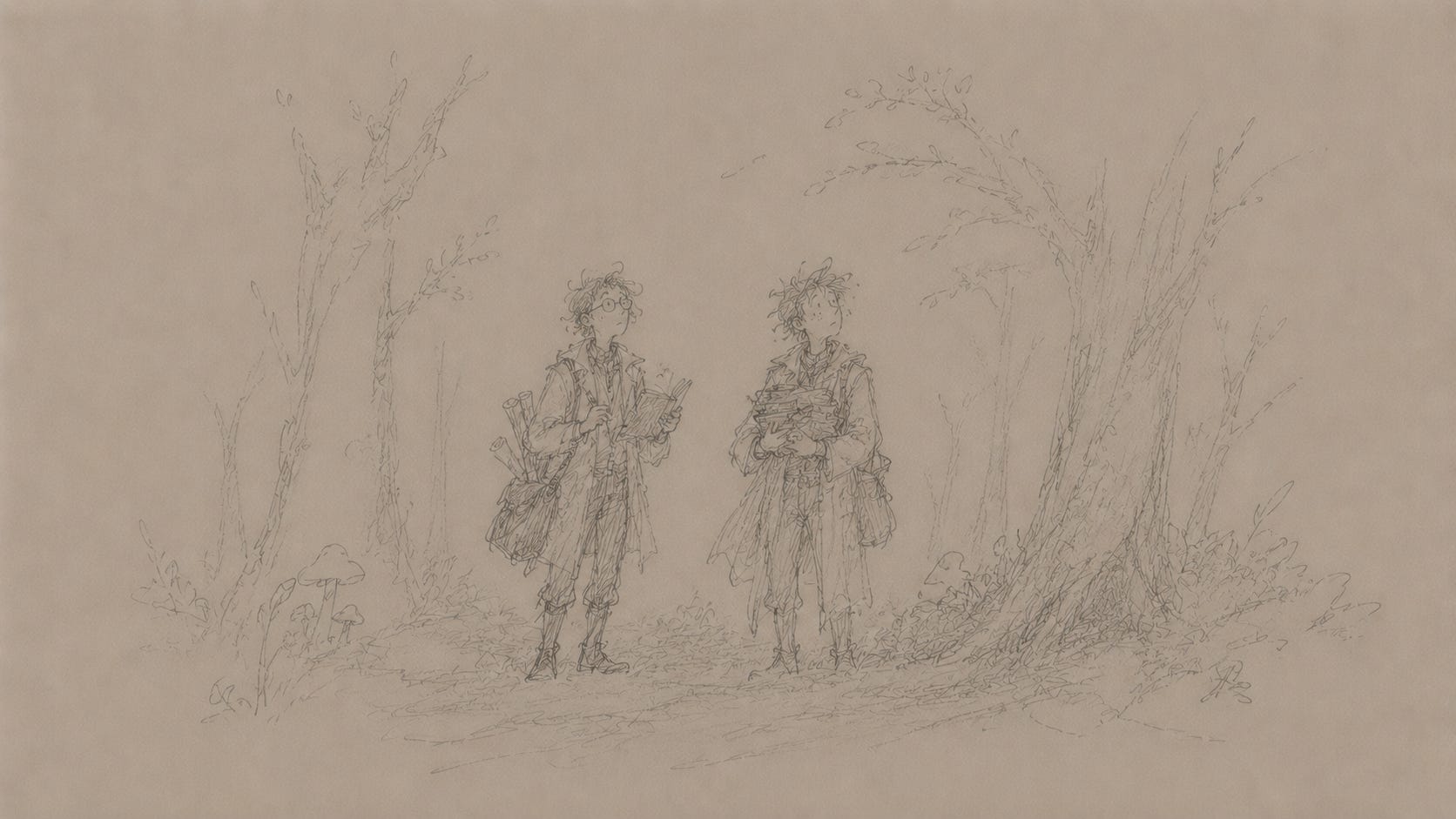
“What do you make of this Cinter?” Yes, my colleague and confidant for this journey, the SXICC rarely let individuals traverse alone due to irredeemable resolutions toward personal bias, Lemp Trolga, a mossfellow soft and green, who pulled his face together to resemble something I would usually communicate with. This was an unnecessary politeness, as I’d been friends with Lemp for decades at this point, but appreciated nonetheless as otherwise it would appear as though I were having fully intelligent conversations with a human-like pile of moss in a flannel with its sleeves rolled up a quarter.
“There’s nothing in our learnings to indicate that this is a normal or expected encounter,” I started, “so therefore we must treat this expeditiously as an anomaly. We shan’t return to Xameryth until the answer is uncovered, wherever we find this answer, no matter the perils which may arise.” I clasped Lemp’s shoulder, but not too roughly as his vegetatious flesh was want to pull away rather easily, “This may very well significantly lengthen our journey, Lemp, are you prepared for all the sacrifices we might need to make in our great chase for the lost city?”
Lemp’s expression was, at best, hard to read, though I account this more to the fact that, again, his face was something he pulled together for the sake of speaking with other humanoids and not something which occurred naturally, so microexpressions of emotion and cognition were even less of a priority for mossfolk. “For the sake of SXICC, I think we very well must hound this mystery until satisfaction can be found.” With Lemp’s characteristic cheekiness, he added, “Besides, s’not like your efforts will be any help in perilous situations. So’ve got to stick around.”
Lemp arrived on Xamerynth clinging to the back of their partner, though they would embarrassedly contextualize not romantically, Sarah, who was a stonefolk of a pumice-variety, and managed to float her way to Xamerynth, though both her and Lemp have differing accounts on how long the journey took, with Sarah claiming it was just a short while, and Lemp stating it was practically forever. The story goes that, when Sarah and Lemp near the Mad-Toothed Brink, there were a handful of onlookers watching as the pair attempted to battle their way up the slick and stark surface. After a few tries to climb the cliff walls, they watched as Lemp clumped towards the back of Sarah and released an immense jet of flame into the water, which effectively jettisoned the two up the wall, skipping Sarah’s form across the surface like one would skip a rock across a pond. In the years since, Lemp has come to appreciate his powers more, but it doesn’t excuse the oddity of a mossfolk who’d been gifted efforts of flame.
With a firm nod, we dismissed each other to our specialties: Lemp strode to the center of the clearing and I watched as his body flattened to the ground, spreading as he did so. The flannel he wore was actually an extension of his moss, just of different colors and textures to give the appearance of clothing, and so stretched with him. He described this as something like interviewing the vegetation of the area, and though it was not something he could do often, he would deploy this tactic for extraordinary circumstances and a completely disappeared city must have qualified in his taxonomy of extraordinariness.
I whiled away the time trying to take stock of the Blind around the clearing: trying to find paths outward, any damage to surrounding flora that would indicate large structures pushed or pulled through, any recent footprints, and the type of flora that existed on the fringe. There were three primary paths from the clearing: the southern path we arrived from and which would have a traveller heading to the coast and the Torrence Swamps, a northern path which ought to send interested travelers to the city of Beeley, if that were still there, in a week-to-two-week’s time, and a western path which headed toward the city of Gario. The path to Gario was documented as the most well-maintained path, as it was the most readily available and the quickest path to a neighboring society for Wul. Plus, Gario demanded much trade due to its infertile mountainscapes, so Wul’s citizens profited from guiding merchants from around Cleff through to Gario. There were a couple trees felled to the north and chips of damage to other trees in the vicinity, but this seemed less like someone pulled large buildings and materials through (because the damage stopped after a small area), and more like something of a conflict occurred there. Otherwise, the paths were slightly overgrown but still visible, and the surrounding landscape looked… fine? The vegetation was what I would expect for fringe flora, simple mycelia structures and berry bushes alongside large trees which had non-competing access through their canopy to the light provided, as opposed to deeper flora like vines and nests which would have indicated that the forest had overgrown but had been cleared recently.
As I finished my third lap around the clearing, Lemp pulled himself back together and strode over to me in his typically nonchalant fashion, “None of the plants around here know anything about a people or a city,” he said. “Of course the plants who are growing in the clearing and around the fringe are all likely to not have been around for more than a year, few years at most, so it’s possible that the city was gone far before their time.”
I nodded, though can’t confess I truly understand the knowledge capacities of weeds. “So we are at square one.” Lemp blinked at me, not comprehending. “So we are effectively no closer to obtaining an answer than the moment which we stepped into the clearing and discovered there was a question.”
Lemp smiled, “Seems so!”
“Alright,” I began large strides, circles around Lemp. Everybody knew that the larger a stride you took, the more thought was happening between words. “I don’t believe there is literature toward the study of singularly disappearing cities,” Lemp muffled agreement, “and therein it feels safe to assume there is not a literature toward the study of tracking disappeared cities. What does this tell us Lemp?”
“We’re winging it?” Lemp asked.
“Let’s reframe the question: we’re groundbreakers Lemp! And, more importantly, there is simply no justifiable cause for our sudden return to Xameryth ahead of schedule, as there is nothing to be found within the archives that may aid us in this more pivotal of questions.”
Lemp jumped a little at the mention of groundbreaking, but smiled in the way that moss may smile, “Yes! We shan’t return to Xameryth early!”
“So,” I started, my limber legs lugging me around Lemp faster and faster, “I would hypothesize there are two base classifications of tracking: tracking things that do not wish to be found versus tracking things that do wish to be found—”
Lemp interrupts, “and a third: tracking things that do not know if they wish to be found or that being found is possible.”
“Right you are Lemp, yes, three classifications of tracking.” I stopped suddenly, taking a few gasping breaths before continuing my pace, “do any of the three categories seem more or less aligned with what we expect a city to respond?”
“Well.” Lemp started, “if we know that Wul was indeed a city, and a city is a large, important community, beloved by its people, then I think we can assume that its people would want Wul to be found.”
“But then we have the case of things like hoarding, where we hide treasures we do not wish others to acknowledge or know of,” I countered.
“Right, yes, I have stepped too quickly!” Lemp said, “So, then, if a city is defined by the presence and cherishment of its people, a people could not exist without access to survival needs—food, water, shelter, the like—and would not cherish if these needs were not met more than adequately.”
“Ah, excellent Lemp! Yes, yes! So what does this mean?” I asked.
“If Wul is indeed still a city, then it still has people, and these people still have needs which need be met more than basically. So, if it has disappeared, then wherever it has gone to would need to have access to provisions beyond basic survival.” Lemp said exasperatedly.
“Where on Cleff has the environment to support its people in a similar fashion to what Wul has found previously?” I pontificated, “That isn’t already populated, of course.” Then, “I would have to imagine either the Hero’s Respite, although that is awfully close to the Plielands, or the Runerastle, which seems a bit dangerous; however, for a city accustomed to Tinnen’s Blind, is probably of a similar generally threatening reception to the Blind.”
“Don’t forget the third option,” Lemp said, “which is that they have discovered something utterly and entirely new and which we have no documentation of previously.”
“I don’t want to discount that possibility but, “I scoffed, “Lemp our ancestors have scoured Cleff, and it is extremely well-documented. Don’t you think it’d be extremely unlikely?”
“As unlikely as an entire city disappearing?” Lemp said.
“Point taken.” Finished with my laps around Lemp, I tutted my way to a conversational proximity once more and offered, “My instinct is telling me to head to Gario, as it’s the closest to most of the locales that might host a Wullian transfer, and would be the most affected if Wul trade routes were disrupted. Do you have other recommendations we should consider?”
Minutes long silence went by. I had thought Lemp had taken to his periodical napping that he is want to do, or perhaps had been communing with the local flora once more to try and ascertain some new or interesting insight. There were many things we did not know about Cleff. Many inexplicable experiences and civilizations that we have found artifacts from despite a lack fo record for. Combing the beaches, especially, tended to result in the retrieval of odd materials or structures that had washed ashore but for which we had truly no historical explanation or reference toward. In fact, even in the most recent documentation of the SXICC the previous researchers had documented that they’d found evidence of a new type of creature that’d been spawning within the Eugen jungle and expanded to occupying the Northernmost parts of Tinnen’s Blind as well. Still, it seemed rather suspect that an entire city and near all evidence of its existence had simply disappeared from a massive swathe of land. Nevertheless, Lemp replied, “Nope! Sounds good to me.”
I peered around at the unwelcoming and unflinching visage of Tinnen’s Blind around me. I tried to consult the sky, the clouds, the position of the sun. And after a few moments I looked back at Lemp and asked, “It appears in all of my circling, I have lost myself. Do you know the way to Gario?”
Lemp pointed in a direction and said, “Pretty sure it’s that way.”
“Lemp I must stress that it is no small threat to lose oneself in the Blind. So I ask this not with doubts to your expertise or experience, but rather for our continued safety, what makes you say pretty sure?”
“Oh, I was just guessing.” Lemp said, “I can ask around though but the plants don’t really know human names.”
“Do they know what mountains are?”
“That’s easier to describe, yeah.”
“So could you… ask them where the forest meets the mountain?”
“Oh! That’s smart, yes, they should be able to answer that.”
Lemp’s form flattened into the soil and seemed to spread out for a minute, two, three. Then, recomposing itself with a slowness, his mouth sliding up with the rest of his fleshlike surface as he grew in height, “I was wrong, it’s actually that way.” And before his arm had solidified an appendage there was something of a pointing he conducted about sixty degrees further clockwise from the first direction he’d pointed, “If we’d gone the direction I’d initially pointed, Cinter, we’d be walking for quite some time before probably ending up near Slico. Well, if Slico hasn’t disappeared too.”
“That is a possibility, I suppose, but let’s refrain from the idolatries and pleasures of Slico until we’ve satisfied our investigative need, yeah?” I said, linking an arm around Lemp’s newly composed shoulders. They were soft, spongelike, but he always told me he appreciated being touched as many did not extend that most basic of physical intimacies toward him on account of his less traditionally skinlike appearance.
“Right, Cinter, shall we tary through the Blind and try to uncover any new secrets here first, or approach this quest as a singular objective for now until our query is satisfied?”
“I should think there is always time for tarying Lemp. That! is the true nature of a sxiccian researcher. We are scholars, sure, but first and foremost we are troublesomely curious.”