

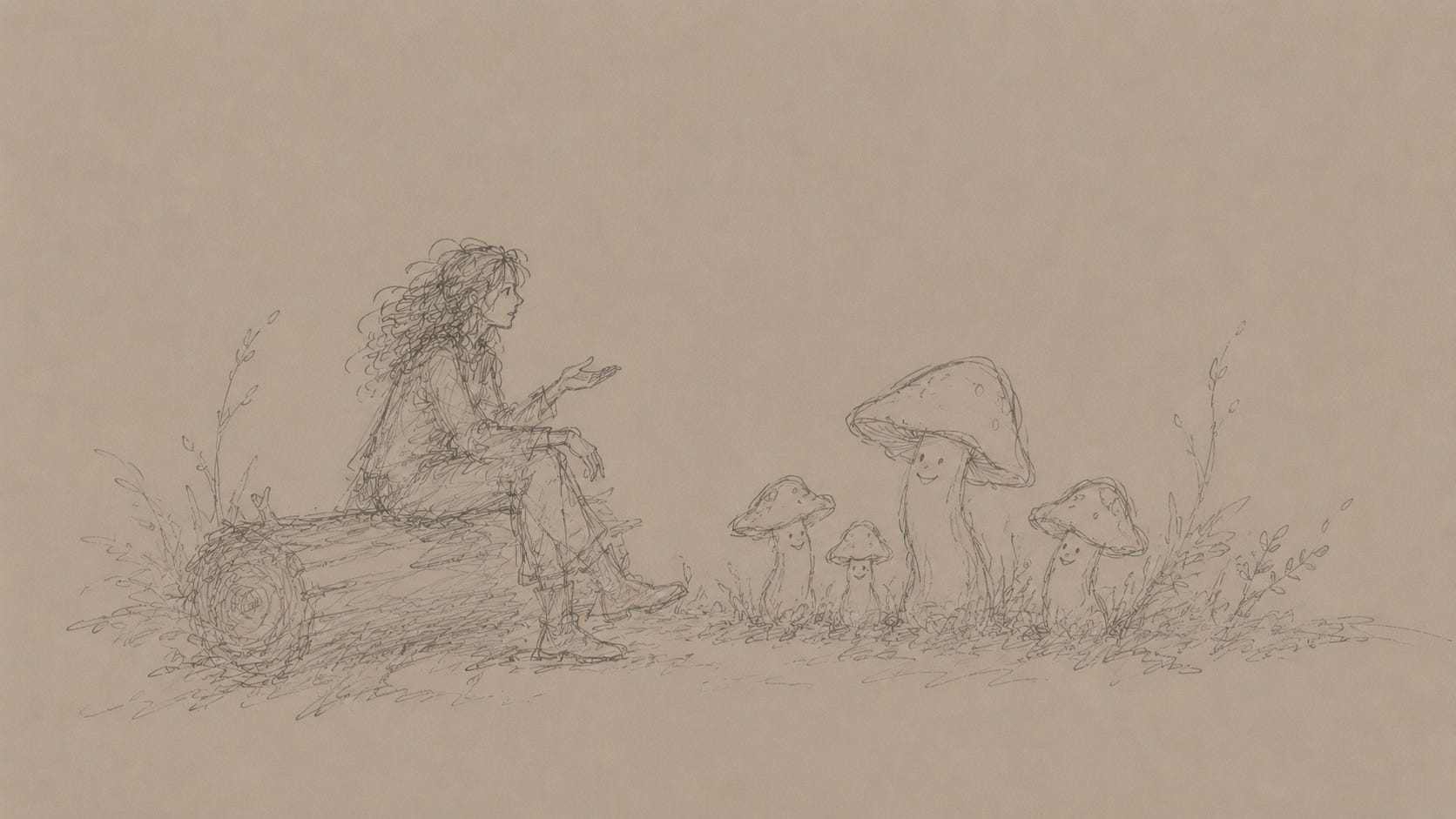
Playing with Invisible Beings and Shadows
Leaving room for myth, most would tell you that long-term survival outside of a city was nothing short of miraculous. By count, it has been three years and eight months since she last slept among the company of other people. Three years and eight months since she set off from the Plielands to explore the world some.
Her first thought was to try for Gario - she’d imagined it would be one of the most culturally dissonant areas to her fairly calm and simple upbringing in the Plielands. Have you ever wondered what it would like to truly find opposite enchantments to your everyday? It seems either incredibly brave or intolerably stupid to set out in pursuit of this opposite. Yet, that is exactly what Clara DeLelliam did.
The journey through the Plielands, along and through the Hero’s Respite, was pleasant and with hardly any trouble.
Clara, in order to prepare, adhered to Pliean custom and traveled to the Northernmost shore of Cleff, saw purchase of the Might, that frozen mass of land, and assembled something of a strung together raft to try to get there. To her surprise, the journey was calm, with a clear surface to the water, only small fishes bobbling alongside, and minimal waves, she made it a fair distance from shore before the wind and the cold took her back, forcing her to either paddle viciously to push through unyielding currents, or acquiesce and agree that she was simply not intended to get to the Might proper. So, she returned to shore, returned to her home and assembled her pack more properly for a journey, having been satisfied with the measure of her endurance and capacity.
Born to a family of powersborn, the DeLelliam’s were well-known through the Plielands for their ability to exert some effortful control over the more static objects in nature: stonemelders and soilshifters. They were half-gnome, half-dwarf yet strode around the area with an efficiency of purpose that did not become the relatively miniscule reach of their step. Yet Clara, the most adventurous looking in her desires, had not exhibited any powers of her own that would aid in her journeys. Nevertheless, the Plielands had a reverence toward the land of Cleff, and this utmost belief that if the land were trying to do one harm, it would certainly find way to accomplish this harm aided Clara’s argument that, clearly, her intents are understood and, so long as she kept a steady mind listening to the elements, she would come to no harm herself.
It was with a tremendous pack, one nearly twice the size of her body, that Clara set off from the Plielands with the intent to head toward the northernmost path up Royson’s Unbound. According to her family, this approach was the most friendly toward those on the smaller spectrum due to minimizing the need to strictly climb up rock surfaces. Yet it was exactly this approach which would be the source of her distraction.
The pathhead toward Gario was located within the Echo of Naja, a fairly small forest compared to its neighboring Eugen Jungle, or to its cousins to the south like the Runerastle or the Trembling Wilds, but dense and dark and full with life nonetheless. Naja theirself had been lost to history, only rumors and hearsay left to provide any indication toward what their story was that led to a forest being named after them, unlike miss Hazel Tinnen who allegedly has something of a monument to her being within the Blind of a forest named after her. The Echo of Naja was rarely frequented, though: Beeley had long abandoned efforts to send travelers out into the world, Wul had its own path to reach toward Gario, and there was a significantly shorter path to Gario from the Plielands assuming you had the company or reach to scale a few dozen feet worth of assorted rockwalls. Not particularly difficult climbs in their own right, but when your fingers reach a max of four feet and you’re weighing a pack that weighs just as much if not more than you, the ascent becomes much more tedious to the point of wanting alternatives.
The journey to the Echo had such troubles as: having to skip from rock to rock over a babbling stream or risk getting a slightly dampened foot, having to avoid plucking too many of the wildberries along the way due to having limited basket space (and because of their notable lethargic effect on a body heightened due to her small stature, which yielded more than one nap on occasion). And even during the parts of the Hero’s Respite which were covered more by foliage, where the sunlight did not pierce the canopy overhead and there were present the fears that some beasty was lurking, ready to strike or worse steal her dinner, Clara was never bothered by the world around her.
It was in the Echo where fate began to shift, gradually at first and then in great heaps, for Clara DeLelliam. On paper, the journey through the Echo to the trailhead would only take a day and a half, maybe two if terrain had grown rugged or you were meandering tremendously. But most, due to the general distrust of dark places, would try to make the venture with only one evening spent camped out in the everdark underside to the canopy.
Clara, however, having never ventured out in the world before and, truthfully not having spent much time in a forest, was awestruck. There were flowers along trees. There were flowers in the canopy, a nest of roots between interwoven branches. There were flowers she’d never seen before with odd helical and conical structures, which didn’t seem ideal for little insects to spread their pollen and so which made her wonder how these flowers spread their roots so to speak. But aside from flowers: everything was so alive. She could witness the passing of time in the ways the trees shifted to find more morsels of sunlight, in the ways different wildlife came out and crowed their noises at different hours of the day.
It is one thing to expand one’s world. To incorporate more knowledge and feeling toward what’s real and present around you and simultaneously understand that what’s real and present around you is simply so much more voluminous than you’d previously understood. It is another thing entirely to sit in the mostly dark, dense forest, surrounded by nothing but life in all its glories and uglies, suddenly realizing that perhaps it was your upbringing or perhaps it was your world, but you could sit and admire this new teeming world for ages. That though within you resides still the desire to venture forth and learn more about every novel thing in the world, the sudden dawning realization that perhaps every thing is too much to try and know and instead the matter is to learn enough until one is satisfied by the areas one has encountered and can feel endlessly encouraged of their inquisitiveness. That there is a satiation that is possible in exploration. Without anxiety, these realizations can occur to one at any odd point in the process of exploration.
The question then becomes: what happens if you feel as though you’ve approached satiety in a relatively uninhabited, relatively small-by-classification forest, fairly isolated from the rest of the world but equidistant from three fairly well-established cities. Do you stay, trying to humor yourself through the capacity of survival and encouraging? And what of others: surely one cannot truly find satiety without at least one other person to join them in the laughter and the singing?
But for Clara, these questions did not slow the depth with which her feet descended and became roots of her being. Clara did not both with much of a shelter creation, finding some vines that created something of a cover and piling some mosses together for a pillow, and largely entrusting that danger, if it had been meant to find her, would have already found her.
Sure, at first, there were some nagging voices in her mind, other figures in her life harking about the need for direction or purpose, other figures warning that too long without contact to others would make of anyone a looseminded individual, and the vast majority of voices that seemed to indicate that Cleff, this beautiful world she strode out into and was welcomed by, was an incurably threatening world—that Cleff was home to all number of predatory flora and fauna who would make of her an unwilling meal should she let her guard down whatsoever. And these voices almost succeeded in influencing her actions: there were times, in the early days, when Clara would chance upon a fallen branch that seemed perfectly suited for sharpening into a spear; or, other times, where she’d notice that there was a small horde of corpses of creatures who piled up under this vibrant orange bloom of flower, leading her to understand that something about that flower was a deathly poison of some kind, and would almost certainly benefit her if she could propagate that plant outside of her residence. Behind these voices, and in front of, and to the side of, and within, and all other directions of influence, though, Clara felt a self-assuredness which spoke If you’d need of weapons, defenses, or anything of note, wouldn’t you have already have needed these items? And if you hadn’t been equipped with what you needed, wouldn’t you have already suffered some injury or punishment for being ill-equipped?
Equippage ignored, shelter largely only being sought for minor added comforts, Clara began to make a life based on what was provided to her and what she was directed toward. Freshly killed animalia which, with a light and controlled fire, could be cooked into giving her some supply of meat. Stone structures which served as perfectly adequate for crushing, grinding, and pounding various nuts, fruits, and other foraged vegetation into suitable meals for herself. The wafting smell of wildflowers which lead her feet to a small stream of utterly clear, pristine water and the humming journey where she followed the stream to a natural spring, a pond maybe ten feet wide, which she graced into the company of an adult Splithorn, full-bodied appearing three or even four times the size of Clara, who had also been taking a drink.
Somehow, Echo of Naja provided for Clara everything necessary of living: comforts and food and water and peace.
It was in this way, weeks or months into her stay in the forest, it is hard to say for voices tend to be heard often and who can say what is the originary influence toward a thought, that Clara DeLelliam realized that she too had been born with powers. Or perhaps, more specific, was born with an attunement to the world that was more closely aligned with that of a powersborn. She realized that the unyielding voice, what she’d long-considered her self-assuredness, was in fact a spirit. Or maybe many spirits.
She realized this one day when, having a conversation with herself, she realized the answers were in an unfamiliar voice, and she had not been considering the perspective or phrase beforehand.
“...It is quite a delight to hear you name things that already have names,” Self-assuredness said.
Clara answers, “Well a limean cornbubble just makes sense. It’s practically lime-green, an elongated tubelike flower with bubbles of seed-expression.”
“Yes, and there are all number of travelers and ancients who’ve wandered these forests without considering our thoughts and feelings with regards to a name.”
“And you’re saying I am considering it?” Clara questions, the view in front of her being just infinite trees, a handful of bushes, a fallen log overgrown with mosses and which she knew contained a nest of what she’d called a climbing badger due to the fact that it was a badger which could blimp.
“Well you’re listening to us now, aren’t you?”
It was with this question that, after most of her life spent assuming that the voice which had always held conversations with her in her head was simply her own internal monologue, not dissimilar to anyone else who asked themselves questions, Clara realized: her internal monologue was a voice she’d never heard another person utter. “Wait a second.” Clara said, “Who is us?”
Now to many, Clara’s questioning may appear natural. As one goes beyond those first few weeks of isolation, and approaches that monumental territory of eight months without having spoken to another humanoid, it is natural to lose one’s mind a bit and begin to hallucinate voices. Yet, the voice continued, “We are all around you,” and a simple pause as a wind seemed to apparate where there’d been stillness previously, “the bushes and the dirt, the trees and the flowers,” everything around her whistling and dancing in her vision, “we are the living.”
“So you’ve just been with me all this time?” Clara asked, squatting down to her ankles and then planting her butt to the ground, palms splayed behind her for support.
“Yes and no.” There was a small whirl as leaves and branches and flowers seemed to get strung along into the vague outline of a person, “You listen to us, and we are what is present around you.”
Clara stared at this conjuring of a person, rubbed her eyes with her less dirty hand, and then gawked once more in silence.
“We cannot say who was with you before, but we are here in this forest,” the collection of various foliage dropped into a squatting-sitting position adjacent to Clara.
“Oh. Is that just what this forest is like? You speak to the people who come by?” Clara asked.
“No, Clara, nobody listens.”
“So I’m different.”
“Yes, Clara, you are different.”
“Am I in danger?”
“Do you feel threatened?”
“No.”
“Then you are not in danger.”
“Is what I feel what brings you to life?”
“We are not sure what brings us to life. We have not considered this. We have been as this forest since the forest was just three tree sproutlings, those trees now long dead but their lineage filling out this landscape you see around us.”
“So you were three trees and now you are many.”
“That feels reductive Clara.”
“Okay, sorry.”
There was a minutes-long silence before, “We believe we are what your kind would refer to as spirits.”
“Oh, but I was told spirits are scary and spiteful.”
“Do you feel we are scary and spiteful?”
“I don’t think spiteful, but it is a little scary, I’m not going to lie, to suddenly find a vague-body composed in front of you by loose sticks and branches and leaves.” Clara said, twiddling her index finger into the dirt.
“We thought it would give you comfort to speak to something tangible rather than to our voice all the time,” their form started shaking as twigs and leaves started to slake off, “we can return to just being a voice though if it gives you comfort—”
“No, no, it’s alright, you’re right I wouldn’t have believed you all were separate from me without the body.” Then Clara added, “Besides I get the feeling that if you wanted to hurt or kill me, you could do that pretty easily.”
“Yes and no, Clara.”
“What does that mean?”
“We could hurt others, yes, especially those who wish to do us harm. But we could not hurt you, no, for you wish absolutely no harm. We have even tested you.”
“Oh.” Then, “Wait. Can all spirits not hurt me?”
“We dare not speak for all spirits as there are spirits who would speak for all spirits, and they are immensely powerful.” Then, “we are afraid of those spirits.”
“Got it. Everywhere I’ve gone, it feels as though if I’ve ever approached something dangerous, I’ve had, what I thought, was my intuition call out to me and tell me to turn around, or do something differently, or take some action, like once I was with some cousins and I was dancing on a stump, and I heard something tell me that our celebration was welcome but that I shouldn’t put my feet where they don’t belong, so I made amends by collecting wildflowers from around the area and placing them on the stump, and then we were fine, but I get the feeling if I kept dancing we would have been in a lot of trouble.”
There was another minutes-long silence from the spirit before, “Yes that seems to us as though a spirit were warning you.”
“So long as I’ve listened to the spirits I haven’t gotten hurt.”
The spirit didn’t respond to this and instead just sat adjacent to her, occasionally adding a twig or a leaf or a petal to their form. But, after enough time, Clara stood up, abrupt, and said, “I like learning from you. Them? You all?”
“Because we voice many, we are we.”
“Oh so you’re like a collage? How do you only have one voice?”
This marked the transition for Clara DeLelliam from haphazard adventurer to a voice of the spirits. What first felt like enchantment and almost a trap that Clara had fallen into, Clara realized was in fact simply camaraderie, that the forest was offering her a friend that truly seemed to understand her, and in that way, who was she to want to leave? Years would go by as she learned the ins and outs of the Echo of Naja in its entirety. Its waning desire for expansion, the ways in which it nurtured new growth, the fondness it held for all the creatures living within, the grief it felt whenever anything, miniscule or otherwise, passed away due to age or illness. Clara spent ages wandering through the different lengths of the forest, coming to know its caves and holes intimately, even coming into contact with much of its wildlife: grumbles and thorncats, scalefins and rustlewings, glassgnats and paddocks.
Learning and the pursuit of coming to know an entity as massive as an entire forest are ages long efforts and Clara did not consider herself as particularly accomplished in knowing the Echo of Naja. Yet, the insisting thought wouldn’t stop plaguing her mind: a voice needs ears to listen. With so long spent listening to the voice of the Echo, Clara wonders each day if she would still be able to hear other spirits should she step outside of its embrace.
It was during one of these meandering expanses of thought that she found herself interrupted this day, by the Echo, who had come to her in the form of a mushroom colony growing alongside an Elm tree.
“We are not sure if our voice is different from other spirits’ voices. We can communicate with other spirits, but it is more like intent and feeling rather than language,” Echo’s voice spoke up.
“What’s the point of my being able to hear you all if I can’t speak on your behalf to other people?” Clara asks.
Echo says, “We think one is lucky to ever have one listener to their innermost thoughts and feelings, and that one may live entire lives without finding that listener.”
“Is it enough? Listening?” Clara asks.
“It was everything,” Echo says.