

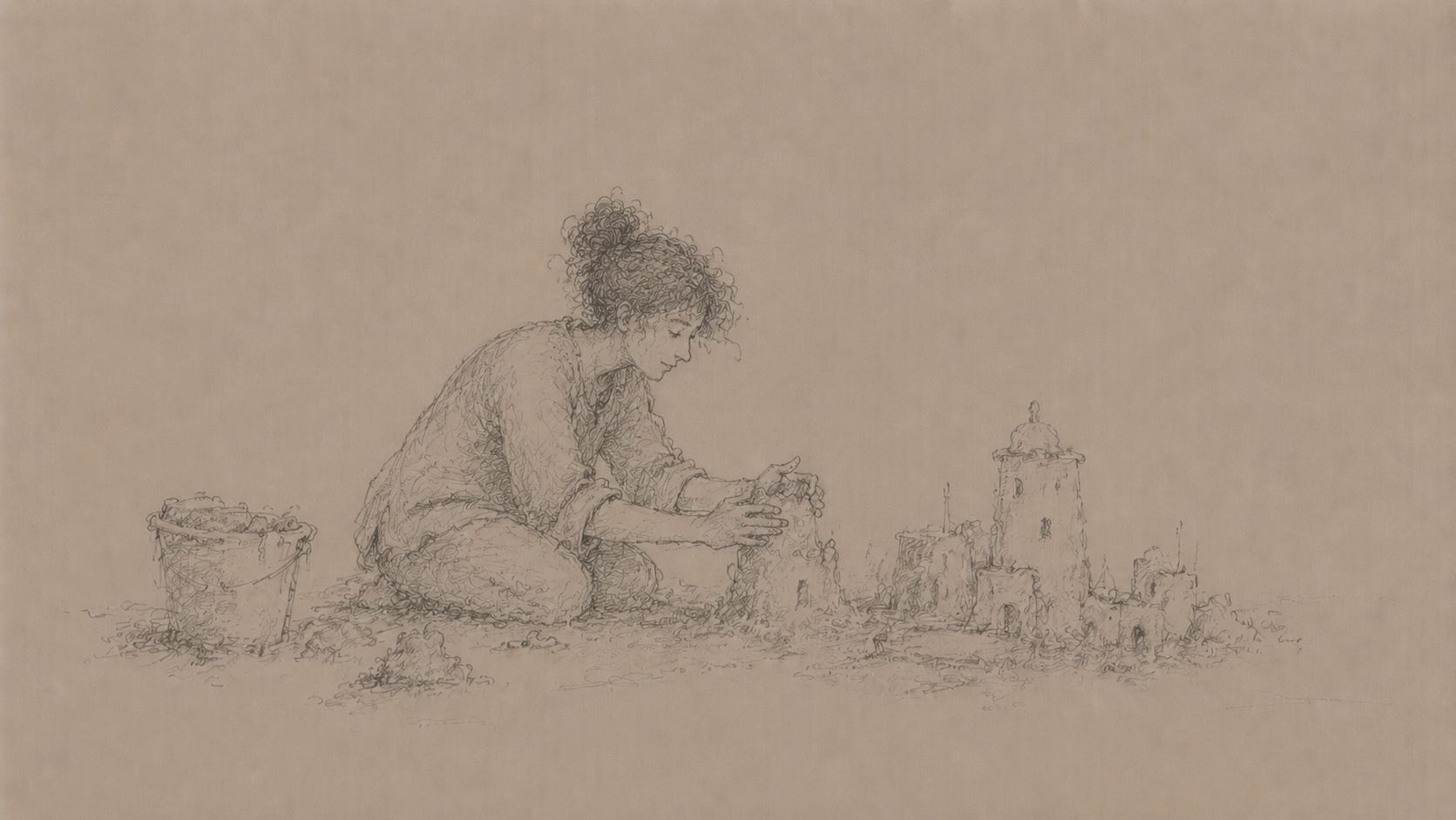
It Was Water
Mud was surprisingly well put together, all things considered. I had been making homes out of the dirt and Mud came to me, standing maybe nine feet tall, no drips or oozings or bad smells. They told me they missed when their siblings would visit. They told me they missed the spirits of rain on dry ground, standing and running water, and the runoff from a canopy after a hard rain. That they could not say how long it had been since they’d been able to spend time with their siblings.
The way it worked was: I would set out and pour all of my heart into the intention of making homes out of the dirt, and Mud would arrive. Here in Khoyver, some of the scholars in town and especially the Shacaster Research Society or the SXICC’s from Xameryth, always were so eager and even desperate to understand exactly what goes in to summoning and talking to a spirit.
I’ve always felt that understanding has been a focus for too long. What happened to good ol’ feeling? Being present?
So when they asked me to tell them the story of how I reunited Mud with their siblings, this is what I told them:
Don’t have the bones to be much of a proper builder. Arms never got too strong, back can’t handle the lift, legs want to give up midway through the morning. But I’ve always admired the art.
Ever since I was a kid, I loved to watch a home get made or a building get assembled. Lifting walls up, hammering roofs together and the like. After my partner passed on, I was a bit lost for sometime. They were feeble like me and though we took care of each other, these things come for us all. Wasn’t easy getting on. Was on a bench one day after a drizzle, all the builders were tearing down their set-ups and cleaning up, unable to continue in some drenched conditions, and I started kicking the mud at my feet.
Before I knew it, I had made a little outline of a home with the toes of my shoes. This was how it started: years went by where, anytime it rained, I’d go find an empty, out of the way patch of mud, and I’d bring some dryer dirt to mix in for stability. I would make some rough walls, I’d try to build something fully enclosed and it would work. Then I’d try building something with multiple floors and it worked.
Somewhere in my mind, I knew this wasn’t how mud was supposed to work, but who was I to doubt it? For the first time in my life I was able to be a builder, something I had longed to be for decades, a role I had admired the artistry of and yearned, oh did I yearn, to have access to.
When I got particularly good, in the summertime, I found the mud caking and turning into something of a clay: my structures grew rigid and semipermanent. I would hear rumors and gossip around town of people whispering about the “strange clay structures that would pop-up after storms.” They blamed the spirits, but were befuddled about what it meant. There was a town meeting. There were more town meetings. Khoyver, tempestuous as it was, was prone to distracting flights of intrigue and mystery. But nobody seemed to know it was me building these things all along, not some supernatural work intending some greater meeting.
At first the meetings were coming together to figure out who and why. But when these questions were unable to be resolved, folks quickly took to more of an interpretive stance: what did it mean? One man, a half-orc named Thom, was always claiming that it meant disaster was impending, that our city built on knifelike precipices, strung together across bridges and canyons impossibly, would collapse due to our brittleness. Khoyver considered his earnestness each time, but ultimately dismissed it: what could be done, after all, with regard to impending disaster?
Instead, some took to heart that these structures were intended for future sites of development in the city. Yes, I lost many-a-good mud patch this way as buildings would begin popping up wherever I found myself making the muddied structure. Then some tried to interpret my constructions as representations of buildings which already existed, as some revelatory message pointing Khoyverians in the direction to try and ascertain why it is that building was selected. In earnestness, I wasn’t immensely creative myself, and so I found myself often trying to replicate the buildings that struck me as most impressive or beautiful. Yet, when putting their heads together to diagnose a condition for the real structures my constructs were based on, they did find things: cracks in their foundation, clogged pipes, an unfortunately crumbling window frame. Though it certainly was an indirect way of doing so, for quite some time I refused to believe there was any truth or power here; that the town’s finding of faults in buildings I was depicting was more a convenient coincidence of the fact that our buildings were quite old and fallible, and that we ought to do more to maintain their structure over time.
It occurred to me, early on and throughout these discussions, to reveal myself as the builder. But, I ultimately decided to stay hidden because I didn’t think Khoyver needed the answer, they seemed to revel in the indiscernibility of it all. And, besides, they were using these messages as means to finally repair structures that would otherwise have been neglected.
Over the years of doing this, of course there would be dry spells or times when I was simply not feeling particularly well enough to adequately create a structure. In these times, there would be unsettled talk throughout the town; people wondering if the spirits had abandoned us, people wondering if we’d simply repaired all that was necessary, and people wondering if Thom’s prophecy was finally bound to come true. I never corrected them, though, I think we all knew that Thom’s prophecy would eventually come true as disaster awaits predatorily for us all, that it is naive to assume one might never misstep enough to invite disaster.
It was after a particularly length dry spell which even inspired a few individuals to try and replicate my efforts using their well waters, creating amateur mud hovels in their gardens, to much dismay over their inadequate effect and inability to retain shape for weeks in the same way as mine would, that Mud spoke to me.
I had found a particularly hidden grotto this time. Khoyver, as it was, had a seemingly infinite number of locales being made that were perfect for my assemblages due to its blustery and perilous position between mountain peaks that were, in their own ways, also crumbling or coming undone. I couldn’t help myself: a sigh of exasperated relief escaped me as I set to work with my construction and I even began to hum a little tune that I realized I last hummed to my partner all those years ago. Oh, yes, Dara, extraordinary gust that they were.
I spent much of my time remembering days and evenings with Dara, though it had been years since I lost them at this point, cherishing them in my lap or listening to their mrow when they wondered why I didn’t push myself more to pursue the things that would bring me happiness. Before I knew it really, my hands busy as they were pulling mud together and building the outlines of what would be walls, I discovered I was crying. My tears mixing into damp mud mixture, I wiped under my eyes with the back of my hand and laughed thinking about how that would probably lessen the solidity of it all.
That was when I heard behind me, “No, the salt actually helps make things dry out faster and more firm, so, you know, with all things finite, you just need to use it appropriately.” Startled, I stood up and saw Mud behind me for the first time. This first time they appeared rather small, vaguely humanoid but in a condensed frame of all dark brown mud, maybe three feet tall. I didn’t hear them laugh, and their face wasn’t emotive, but I still knew they were laughing as they said, “I was wondering when you’d finally turn around. You know I’ve been watching you all this time, right, dear one?”
Embarrassingly, my instinct got the better of me. I whipped my wrist forward and flung nothing else but a clod of mud at, well, Mud, who took the clod without repose and simply absorbed it into their frame. In the same instant I launched myself in a half-scrambling-on-hands-and-knees, half-hurling motion away from Mud. They merely waited for my panicked energy to dissipate and then offered, “Oftentimes you humanoids, when we visit, will revert to deference or fear-based worshipping, which is hardly any fun at all. I much prefer a response like this, though, admittedly, above all I’d rather you simply acknowledge me with a smile rather than any horror.”
I nodded once before, finally, standing up. “Oh dear,” Mud said and with a wave of what I understood to be an appendage of theirs, maybe even a limb one might say, the array of muddied debris that had spattered my trousers was wiped clean, re-absorbed into them, “there, that seems much more comfortable for you.”
“Can’t say I really mind it too much,” I told Mud, “otherwise why’d I be here?”
“That’s a good point friend.” Mud said and then mostly seemed to stand there, paying me attention but not offering more.
“So, uh,” I rubbed the back of my head, “you don’t mind me building stuff out of you, do you?”
“No, Kilce, I am in fact quite flattered you’ve chosen my medium to make art with.” They whipped an appendage down across their mid-torso and made a dramatic bow.
Mud revealed to me that they’d been along my side for ages. That they were drawn to something about me, something about my spirit and my energy seemed to scream for the in-progress and temporary, for the mess and the muddle. When I first started partaking in Mud, they were elated and wanted to blow their cover immediately; however, they remained patient because my energy was still a bit too in-progress, they didn’t want to risk altering the flow of what may come to be a glorious relationship.
They asked some of the other spirits whom they were close with, those whom were not predatory toward humanoids and instead reveled in something of a relationship with them, spirits like the darkness behind a door, the path home, and invention, who liked to call the Dishook mountains home but was perhaps a bit too large to settle here for very long. Their experiences were that us humanoids would find them when we were ready to, and that should we find them too soon it might mar our ability to reasonably react: we might fear too much, or come to some sense of ego or pride, or claim some ridiculous sense of entitlement. So, Mud waited years for me to turn around one day and grant them the belief necessary to speak. As, this was the important point that Mud stressed, communication between spirits and humanoids simply could not happen if there wasn’t a base acceptance and belief in the spirit.
They tried to explain that, while every spirit has their own form and shape, their own soul and personality, that the humanoid interpretation of the spirit does manifest a type of distortion: Mud exists as Mud does adjacent to me because I believe in the capacity for Mud to not wish me ill, to not want me dead. “It’s a little more complicated than this, and I can’t really explain it more, both from a ‘we spirits are barred from talking too big-picture with the humanoids,’ way, but also in a, ‘if I gave you all of the information at once your little brain might erupt from your skull,’ way,” Mud said.
It was in this cave that, coming to terms of my own grief, folding it into the structures I dreamed of making, Mud confided in me: “Yes, believe it or not we spirits, powerful as we are, also have limitations. It is why so many of us call out or try to find you lot, those of you who can believe in us, to find something of a compromise and shared vitality.”
Our friendship continued like this for some time. I’m not sure how many years it took for Mud to confess what it is they lacked, maybe four, but we continued in this base relationship without much nerve for complication. Khoyver would meet to discuss my structures, they would dispatch teams to study them, they would even come to publish calls for scholars to study the fields and determine their significance from a powers-based perspective. Most who came by would confirm that, yes, these structures were the result of a powersborn; however, seemed like a particularly adept refinement of an overarching ability. Said powersborn, apparently me, would never be revealed to the town.
Instead, Mud would stand or sit or squat at my side, watching me create all manner of structures and remarking about my process, my care, and especially complimenting the vision I carried and my ability to consider causes and effects several stages removed from each other. Yet, as I’ve learned is the nature of most if not all spirit-humanoid relationships, inevitably there will be something that the spirit calls for from their mortal partner, and this is impossible for the humanoid to ignore.
It was the first sunny day after a remarkable four-day-stretch of rain. I had to wander a fair league outside the city to keep to myself as I desired; however, eventually I found a perfect little oasis. Wedged between four massive boulders, this patch of mud stretched like a large carpet, and I knew that when I set into it the structures wouldn’t get discovered for months if not years. As soon as I set my materials down and was able to dig my fingers into the mud, though, I heard their sigh behind me: “Hello, Kilce, do you ever bore of me?” and there was Mud, rising further and further yet, their largest form yet, towering over me yet not losing the signature composure that seemed to always become them.
“No,” I answered, “but I also never see you unless I’ve been looking for you.”
“I don’t bore of you either, but I do wish I had my siblings sometimes. Or I could send a word to them.”
I raised an eyebrow at this, “Spirits have siblings?”
“Oh of course. We don’t have families like you humanoids do, but we do have kin. I call them siblings because it seems convenient for your understanding, but it’s more like how a leaf may consider the other leaves on the same branch,” Mud said.
“I hadn’t considered whether a leaf would think of itself as unique when perceiving its neighboring leaves.” I said.
“Yes, well, that’s an issue for consideration on another occasion.” Then, standing over me, drawing closer, something of a shadow being cast on me, “I have a request for you, and by request I should hope you know you very well can’t ignore me.” The way they said this made me think I very well could ignore them, but that it would not work out in my favor should I wish to continue my endeavors of making buildings out of mud. “We of the aqueous interpretations are all interrelated, you see. Rain on dry ground, standing and running water, and the runoff from a canopy after a hard rain, all sorts of water and watery effects would consider themselves kin to each other. And yet,” they practically tutted to me, though I still did not believe they had any real type of mouth, “I haven’t seen any of them for years. Heard their voices, received their own partners or chosens if they even have any.” Then with a scoff, “Wouldn’t it be something if I, lowly Mud, found a chosen prior to rain of all spirits?”
“Is that what I am? A chosen?” I asked.
“Ah, well, what would you call yourself?” Mud said.
“Chosen’s fine, though seems a little heady and prestigious.” I said.
“Isn’t it prestigious to hold a spirit’s attention and earnest engagement?” Mud asked.
“So how do I find your siblings?” I asked.
“Same way you found me.” Mud said.
“But I didn’t find you,” I said, “you just announced yourself one day.”
“That’s where you’re wrong! I could not have announced myself had your heart not been ready and calling for my voice!” Mud said.
“So… I need to ready my heart to call for the voice of your siblings? I’m not sure how to do that.” I said.
“Well, how did you do it with me?” Mud asked.
“Okay, this isn’t going anywhere.” I said.
“But you’ll attend to my request, Kilce, chosen of Mud?” Mud said, and I swear if they had eyelashes to flutter they would be fluttering.
“Uh, sure—,”
“Excellent!” And with that, Mud simply disappeared from me entirely. It was several moments later that I heard their voice, distant and comforted, saying, “You’ll know how to do this when you know, I’m in no rush, just sometime before you die, please.” And then further yet, “Otherwise I’ll turn you into one of my mud puddles and you’ll be constantly sloughed off by unappreciative travelers.” A pause then, “That’s a joke,” and finally, “But I could.”
Around me were five scholars who were practically frozen in reverence to the information I was disposing to them. There were Archivists Jor and Pend Wendee from Shacaster’s research society, who were each humans and looked the most studious in their expressions. Then there was Provocation Tuf Mantle and Observer Kilian who were the SXICC representatives from Xameryth—apparently these titles were a new structure Xameryth had inscribed to their research society, that every pairing should have someone who excelled in provoking the elements of the world and one who was best suited for acknowledging every reaction therein. Finally, Inquisitor Zyla had stumbled into our impromptu meeting and was listening attentively to my details after putting together that this immense mystery which had been plaguing the city of Khoyver for a decade or more now was, in fact, resolved to one person, myself, Kilce Troumpe, chosen of Mud.
I paused and said, “Now,” I looked around a bit, realizing exactly the gravity of what I was saying, “if you lot don’t mind, I’m quite hungry, not used to talkin’ so much. Maybe you can gather some victuals and come by my place, you can give me some proper meals while I give you some ideas? or questions? that you may have wanted answered for some time, yeah?”